
Rebranding
Rebranding services that keep what customers recognise and fix what no longer fits.
A rebrand should move the business forward without making loyal customers wonder where you went. Our rebranding services start with a brand audit, then separate what still carries recognition from what needs to change. From there, we build the new corporate identity and plan the rebrand rollout in an order your team can actually manage.
- Brand audit before design begins
- A phased rebrand rollout, not a sudden switch
- Old and new brand assets stay organised


Why it holds
A company rebranding agency should protect the recognition you have already earned
Recognition builds slowly. Customers may remember a colour, a shape, part of the name or the way your packaging looks long before they could describe the full identity. A good company rebranding agency finds those signals first, because changing them without a reason can make a familiar business feel unfamiliar overnight.
That is why the brand audit comes before design. We review the identity, website, packaging, templates, social assets and anything suppliers are still using, then decide what stays, what changes and what can be retired. The result may be a focused brand refresh or a wider rebuild, but the decision comes from evidence rather than fatigue with the current look.
The diagnosis
When should a business rebrand? Start with what changed.
A rebrand makes sense when the business has moved beyond the identity it was built with. The trigger might be a new audience, a different product mix, a merger, renaming or a corporate identity that no longer works across the channels customers now use.
-
01
The business grew, but the identity did not
The original identity may have worked perfectly when there were three products and one sales channel. Growth adds new formats, teams and customer touchpoints. If the system cannot stretch with them, people start making one-off fixes and the brand begins to fragment.
-
02
The brand still speaks to your old audience
Your offer can change faster than your visual identity. When the customers buying today are not the people the brand was originally designed to attract, the tone, imagery and presentation start working against the sale. Repositioning often needs a brand refresh before it needs a total rebuild.
-
03
Mergers or acquisitions left more than one identity
Two or three visual systems can each make sense on their own and still feel disconnected under one company. A rebrand gives the combined business one corporate identity, with clear decisions about which names, assets and recognition cues survive the brand migration.
-
04
Your best-selling products no longer fit the system
A new range should not need a separate visual language simply because the old one has no answer for it. When packaging, ecommerce listings or campaigns keep being redesigned outside the system, the brand starts drifting. That is usually a sign the identity needs to expand or be rebuilt.
-
05
The brand works in old formats but fails in new channels
An identity designed for signage or print can fall apart on a phone, marketplace thumbnail or social profile. Small digital spaces expose weak marks, long lockups and layouts that were never designed to crop. A modern rebrand tests those conditions before the new system is approved.
-
06
The message changed, but the look did not
Customers notice when the words promise one kind of business and the visuals suggest another. If your positioning, pricing or offer has moved on, the identity needs to support that change. Otherwise the business is asking customers to resolve the contradiction themselves.
-
A rebrand should solve a business change, not boredom with the current design.
Audit first. Change with a reason.
Before we change anything
Six questions that define the rebrand scope.
These answers tell us whether you need a light brand refresh, a deeper rebrand or a full brand migration. They also shape the cost, the rollout plan and how much change management your team will need after launch.
-
Six questions we answer before design begins
We identify the visual and verbal cues customers already use to recognise you. That might be the name, a colour, a shape, packaging or something less obvious. Anything still earning recognition gets a clear reason before it is changed.
-
Six questions we answer before design begins
Renaming changes more than the logo. It affects search, repeat purchase, packaging, legal documents and every customer who already knows what to ask for. We decide early whether the name stays, evolves or needs its own naming scope.
-
Six questions we answer before design begins
A strong rebrand starts with a specific business reason. Growth, repositioning, a merger or a new market creates a different brief from simply feeling tired of the current design. Knowing why now keeps the project focused when preferences start pulling in different directions.
-
Six questions we answer before design begins
We check whether the people you need to reach are the same people the current brand was built for. If the audience has changed, we look at what they expect from the category without copying the category. That decision influences the visual system, messaging and customer communication plan.
-
Six questions we answer before design begins
We map what physically and digitally exists before choosing a launch date. Packaging, signage, templates, uniforms, store graphics and marketplace assets all have different replacement costs. The rebrand rollout is planned around what can change quickly and what should run out first.
-
Six questions we answer before design begins
A new identity only works if the people using it can keep it consistent. We identify who owns approvals, who briefs suppliers and who maintains the asset library after handover. That gives the project a realistic change management plan instead of leaving the new system to interpretation.
Creative direction
The visual identity design starts before the logo.
We begin by agreeing on the visual territory: what the brand should feel like, what it should avoid and how it should differ from competitors. Moodboards and references make those decisions visible early, while changes are still easy to make.
-
 01
01Identity
The mark the rest of the system is built around.
-
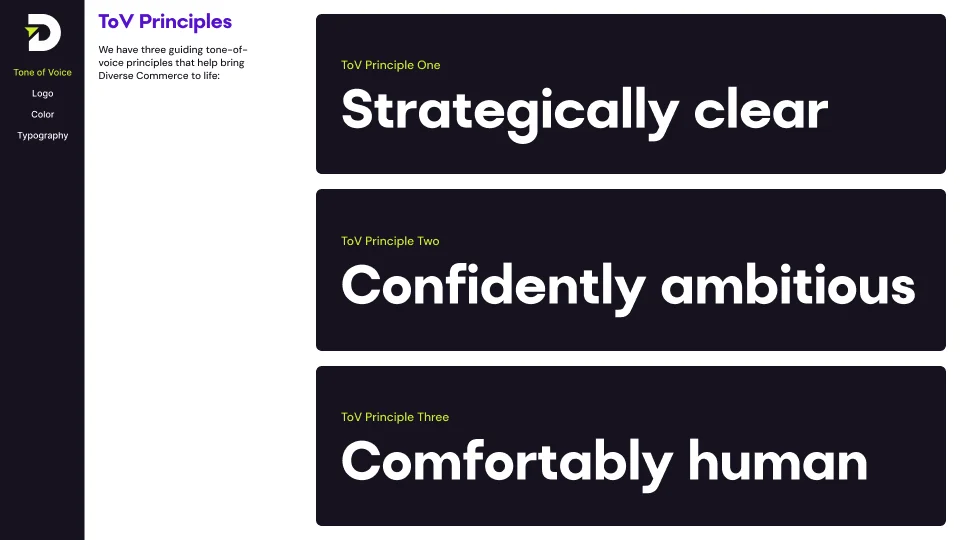 02
02Tone
Quiet, material, unhurried. The opposite of a discount brand.
-
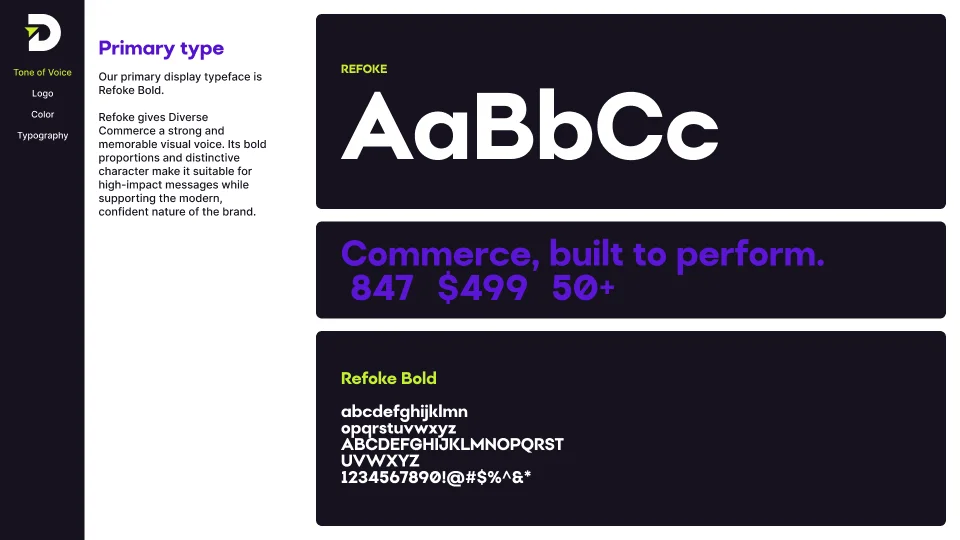 03
03Typography
A heavy display face against a plain text face. Contrast by weight, not by decoration.
-
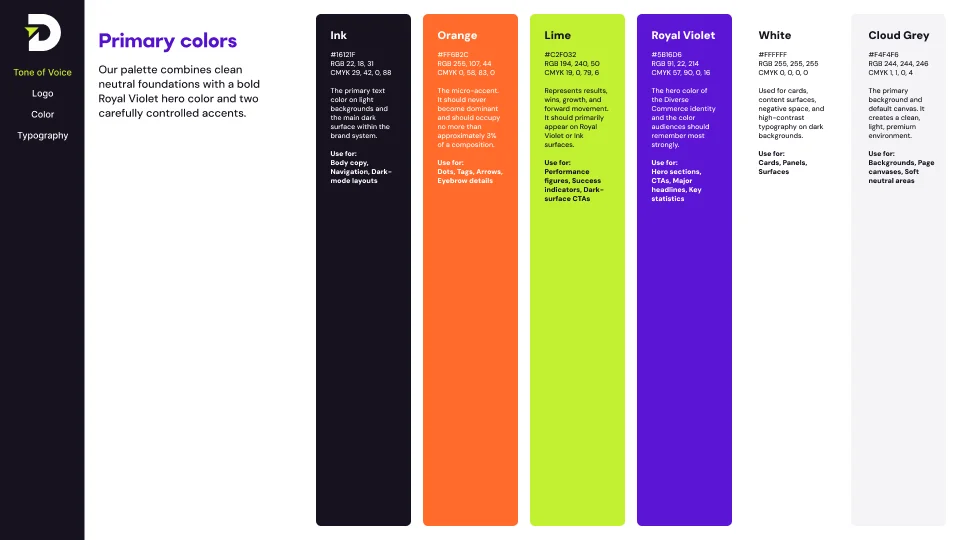 04
04Colour
One ink, one signal, one cue. A fourth colour has to argue its way in.
-
 05
05Image
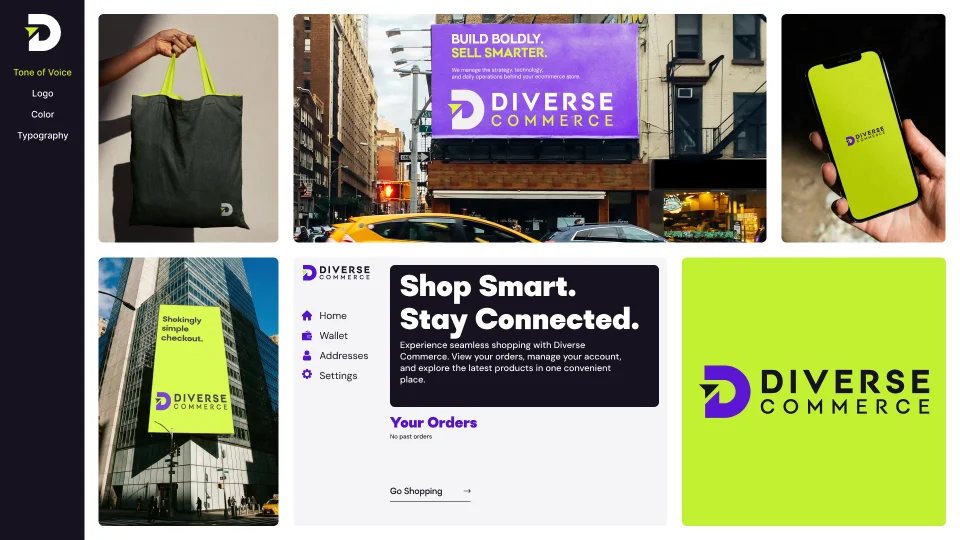
Daylight, close crops, real texture. No cut-outs on white.
-
 06
06Composition
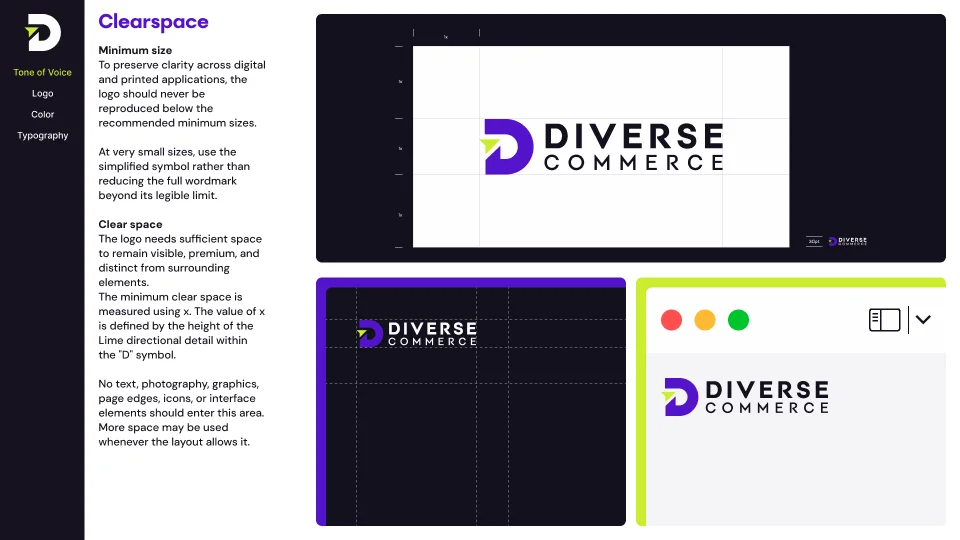
Content sits on a visible grid. Edges are aligned, not centred by eye.
-
 07
07Application
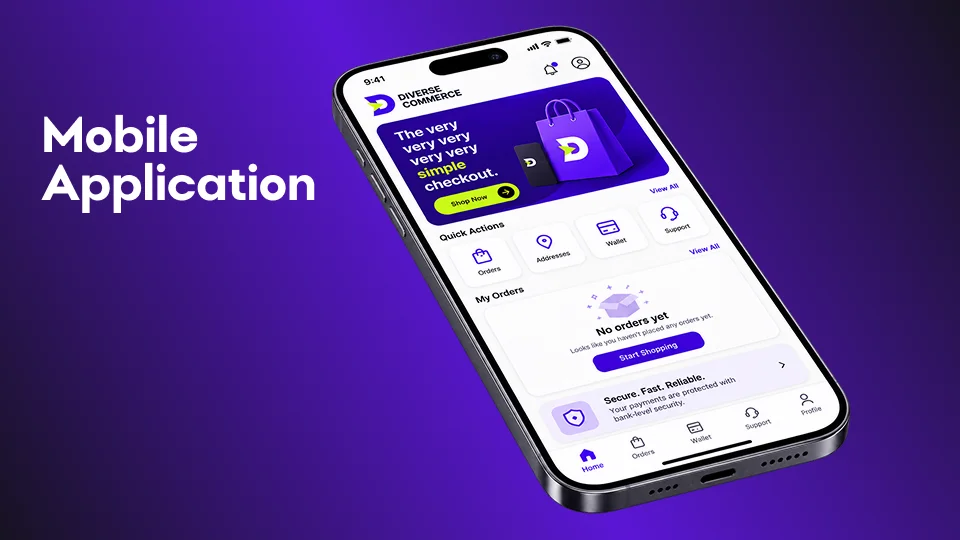
Every decision is tested on a box and a phone before it is signed off.
What you receive
The audit, the new system and a rebrand rollout your team can follow.
A rebrand is easier to manage when the reasoning does not live only in presentation meetings. We deliver the audit, the redesigned system and the order of change so the work can pause, resume or move between teams without losing the decisions behind it.

01 The brand audit
- The brand audit records every relevant asset and gives it a clear verdict: keep, refine, replace or retire.
- Each decision includes the reason, including the parts we deliberately leave unchanged because they still carry recognition.
- This becomes the reference point for the entire rebrand.
02 The new system
- The new corporate identity brings the approved mark, lockups, colour, typography, imagery and layout rules into one working system.
- We show how those decisions behave in real applications rather than leaving them as presentation slides.
- Where the project is a brand refresh, we preserve more of the existing system and rebuild only what is holding the brand back.
03 The rebrand rollout
- The rollout sets the order in which the new identity reaches each channel.
- Digital assets can usually move first, while packaging, printed stock and physical signage may transition as existing inventory runs out.
- We also plan temporary holding states and a customer communication plan where the change needs explanation.
04 Handover and brand migration
- Your team receives the new source files, the archived old files and guidelines for the new system.
- We organise the asset library so people can tell what is current without deleting the history they may still need.
- A walkthrough covers approvals, supplier use and the practical steps for maintaining the brand after launch.
Ownership
You keep the old brand as well as the new one.
Once the agreed project is complete and paid for, the new system transfers to you under the agreed project terms. Your existing files remain yours throughout, and we keep the archive organised as part of the brand migration. That history matters when old packaging, past campaigns or long-standing customers still refer to earlier versions of the brand.
Read how ownership worksWho this is for
Rebranding for small business when the business has outgrown the brand.
-
01
Outgrown
The company is larger, sells more or works across more channels than it did when the identity was created.
A focused rebrand can give that growth a system without throwing away the recognition the business has already built.
-
02
Merged
Two or more identities now sit under one business and customers are seeing the joins.
The work is part design and part change management: decide what survives, build one system and migrate each brand in a sensible order.
-
03
Repositioned
The products, audience or price point have changed, but the brand still presents the business as it used to be.
This often starts with a brand audit because the right answer may be a strategic brand refresh rather than a full replacement.
-
04
Reputation reset
The business needs clear distance from an earlier perception, event or identity.
This is the most sensitive rebrand because visual change alone is rarely enough. The identity, messaging and customer communication plan need to move together.
Branding and marketing services built to work together
Your customers experience one brand, even when the work behind it spans strategy, design, search, content, advertising and customer communication. Our services are built to connect, so each decision supports the next instead of creating another disconnected part of your marketing.
Explore the services below to find the areas your business needs now, while keeping the wider brand consistent as you grow. Whether you start with identity, SEO, content or paid media, every service is designed to work as part of the same system.
- Brand Development Strategy & positioning
- Brand Design Identity & visual system
- Logo Design Mark & lockups
- Brand Guidelines Standards & documentation
- Brand Story & Messaging Voice & language
- Rebranding You are here
- Brand Reputation Reviews & public signals
- SEO Search visibility
- Content Marketing Publishing & distribution
- Meta Ads Paid social
- Facebook Marketing Page & community
- Instagram Marketing Content system
- TikTok Marketing Short-form video
- eBay Marketing Listings & storefront
- Etsy Marketing Discovery & shop
- Google Ads Search advertising
- Google Shopping Ads Product feed advertising
- Email Marketing Lifecycle & flows
Questions
Rebranding questions, answered.
The practical questions that usually decide whether a rebrand is worth doing and how far it should go.
-
A business should consider rebranding when there is a real gap between what the company has become and what the brand still communicates. Common triggers include growth, repositioning, a merger, renaming, expansion into new channels or an identity that no longer works for the audience. If the problem is only inconsistent execution, better guidelines may solve it without a rebrand.
-
That risk is why the audit comes first. We identify the cues customers actually use to recognise the business and protect the ones that still work. The goal is enough change to move forward without making the brand unnecessarily unfamiliar.
-
Usually not. Digital assets are easier to change first, while printed stock and physical materials can move according to cost and remaining inventory. A phased rebrand rollout reduces waste and makes the transition easier for customers and staff to follow.
-
Often, yes. Renaming has a wider effect on search, repeat purchase, legal documents and customer memory, so it should have a clear business reason. We treat naming as a separate decision rather than assuming every rebrand needs a new name.
-
We look at what carries recognition, what still performs well and what creates unnecessary cost or inconsistency. A familiar asset that still works can stay even if we would design it differently today. A weak asset with little recognition is easier to rebuild.
-
Send what people are actually using, including old templates, supplier artwork, current logo files and the messy folders. We also need to understand what changed in the business and why the rebrand is being considered now. That gives the brand audit enough context to separate a real business need from simple design fatigue.
The next step
Start with a brand audit before you start redesigning
Show us the identity customers see today and tell us what changed in the business. We will map what should stay, what needs work and whether the right answer is a brand refresh, a full rebrand or something smaller. That way, design begins with a scope rather than a guess.
A discovery conversation should clarify the problem before it sells the solution. If better documentation or a smaller brand refresh will do the job, that is the direction we will recommend.