
Store building & branding
Build a store that looks ready to lead from day one
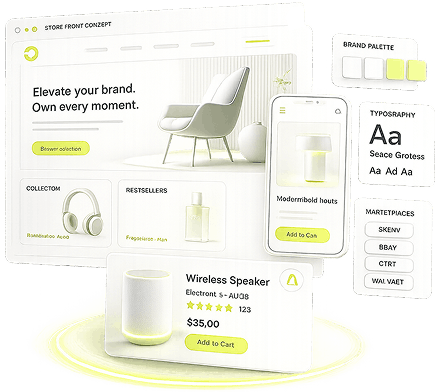
We bring your strategy, brand identity, storefront and product presentation into one practical ecommerce system. Your store should make a strong first impression, feel consistent and help customers buy with confidence.
- Built around your business
- Designed for real marketplaces
- Complete ownership of your assets
Building the identity
The work your brand needs before design begins
A strong ecommerce brand starts before the logo is drawn. Before we choose colours, plan the storefront or build product templates, we work through five connected stages — and each conversation settles a decision the design team will need later.
Your business, in your own words
We start with the basics: what you plan to sell, why this opportunity matters to you and what you want the business to be known for. You do not need a polished brand plan — bring what you know about the products, the customer and the kind of business you want to build, and we will help turn that into a clear direction. When the foundation is clear, later decisions become faster and more consistent.
Discuss your store
Build for the customer most likely to stay
A store does not need to speak to everyone. It needs to connect with the people most likely to trust the brand, return and tell someone else about it. We look at what those customers care about, how they compare products, where they already shop and what they expect from brands in your category. That insight shapes the store, so the right customer can recognise the value quickly.
Discuss your store Decide how the brand should speak
Your brand needs a voice people can recognise, not only a visual style. We set the language for product listings, category pages, promotions and customer communication — tone, key messages, category terms and the claims your business can make with confidence. The store then sounds like one business, even when customers meet it on different pages or platforms.
Discuss your store Turn strategy into a visible identity
This is where custom ecommerce store design and ecommerce branding meet, and the strategy becomes a visual system customers can recognise. We define the logo direction, colour palette, typography, imagery style, product presentation and reusable templates. Those elements are designed to work together across the storefront, listings, social content and promotions — nothing should feel borrowed from a different brand.
Discuss your store Make the store recognisable in its category
Customers will compare your store with the products and sellers beside it, so your position has to make sense in that real setting. We decide how the business should look and speak within its category, where it should stand apart and which cues customers already understand. The same position carries forward as you add products, listings and new content.
Discuss your store 
Strategy meets execution
More than a logo: a commercial identity that works
A logo cannot explain the whole business on its own. Customers also need to understand what you sell, who it is for and why they should trust the offer, so we connect the positioning, storefront structure, customer journey, product presentation and visual identity to support the same commercial goal.
- A clear and credible market position We define the offer, the customer it is built for and the reason it deserves attention in its category.
- A consistent identity across every touchpoint The storefront, listings, product images, social content and customer messages come from the same business.
- Storefront decisions shaped around conversion Clear navigation, sensible page hierarchy and product information that helps customers decide what to do next.
- Reusable assets for continued growth Templates and source files that support new products, campaigns and platforms after the first build is finished.
Where we build
Built for the places where your customers shop
Each ecommerce platform has its own way of presenting products and guiding a purchase. We keep the same brand identity across platforms, then adjust the layout, content and product presentation to suit each environment.
Independent ecommerce stores
We also build independent ecommerce storefronts on established website platforms, including:
We recommend the platform after reviewing your products, technical needs, budget, growth plans and day-to-day operations.
 Shopify
 WooCommerce
 Magento
 BigCommerce
 Wix Ecommerce
 Squarespace Commerce
 WordPress Ecommerce
 OpenCart
 Drupal Ecommerce
 Joomla Ecommerce
 Webflow Ecommerce
Everything we build
Ecommerce development built around your business
Your store structure should follow the products, customer journey and operational needs of the business. We do not start with one template and force every project into it. The platform, page structure and supporting features are selected around how your company sells, how customers make decisions and how your team will manage the store once it is live.
Flexible Shopify stores are built around the way your business actually sells. We organise products, collections, navigation and checkout so customers can move through the store without confusion. Product management stays straightforward for your team, while secure checkout and suitable Shopify themes support a reliable buying experience. Depending on the brand, we can select, adapt or customise a theme so the final store feels consistent with your catalogue, visual identity and day-to-day operational needs.
WooCommerce store development is suited to businesses that want greater control over content, functionality and ownership. We build the store within WordPress, making it easier to combine ecommerce with blogs, guides, service pages or other useful content. The setup can be adapted around your catalogue, payment requirements and customer journey rather than forcing the business into a fixed structure. Your team also retains practical control over updates, content publishing and future development as the store grows.
Magento store development is designed for larger catalogues, complex integrations and enterprise requirements. We structure the environment around product volume, customer groups, pricing rules, operational workflows and any systems that need to connect with the store. Because Magento projects can become difficult to manage without careful planning, we focus on clear architecture, dependable catalogue organisation and practical administration. The result is a store built to support scale without making everyday updates unnecessarily complicated for the internal team.
BigCommerce store development gives growing brands a scalable storefront with strong built-in ecommerce tools. We configure the store around the catalogue, target markets and sales channels, then shape navigation, product presentation and checkout to support a clear buying journey. Multichannel requirements can also be considered from the start, helping the business manage products more consistently across connected platforms. Where needed, the storefront design is adjusted so the brand feels distinctive without creating a system that is difficult to maintain.
Wix ecommerce development works well for smaller catalogues, service businesses and brands that are still developing their offer. We create a polished store that is easy to understand, simple to update and appropriate for the current stage of the business. Product pages, service information, navigation and checkout are arranged around what customers need to know before they buy. The finished setup gives the brand room to present itself professionally without adding tools or complexity that it does not yet need.
Squarespace commerce development is a good fit for brands that depend heavily on visual storytelling and editorial presentation. We use the platform’s clean structure to balance product sales with photography, written content and brand-led pages. Collections, product information and navigation are planned so the store looks refined while remaining easy to use. The design supports the visual character of the brand, but it also keeps practical tasks such as product updates, stock changes and content management manageable for the team.
WordPress ecommerce and web design can bring product sales, content and brand storytelling into one connected website. This works especially well for businesses that rely on blogs, educational resources, service information or a focused landing page alongside their store. We organise the site so visitors can move naturally between learning and buying, without the content feeling separate from the commercial journey. The structure also gives your team room to publish new material and develop the website as the business changes.
OpenCart store development offers a flexible open-source option for businesses that need a structured product catalogue and room for custom development. We organise categories, product data, payment settings and customer-facing pages around the way the business operates. The platform can support tailored functionality where standard store builders may feel restrictive. At the same time, we keep the administration practical, so routine catalogue updates and order management do not depend on constant technical support from a developer.
Why choose us
Why build your store with Diverse Commerce?
Diverse Commerce stays involved beyond the first design handover. The team building your store understands what happens after launch: products are added, campaigns change and the business keeps moving, so the original system needs to remain useful.
-
Commercial thinking from the beginning
We review each creative choice from the shopper’s point of view. The store should look professional and make products easy to understand, compare and purchase. If a visual element gets in the way, we rethink it.
-
One connected brand system
The identity is built to work across the storefront, listings, social content, product imagery, campaigns and future platforms — a working system for the whole business, rather than one attractive page with no plan behind it.
-
Platform-aware design
Marketplaces and ecommerce platforms use different image sizes, navigation patterns, listing fields and content rules. We account for those requirements from the start instead of squeezing a generic layout into the platform later.
-
Designed for growth
The store is planned with future products, categories, campaigns and content in mind. Reusable templates and clear design rules make expansion easier, without rebuilding the identity whenever something changes.
-
Built for your ownership
The store, brand assets, customer relationships, account data and completed creative files remain yours. You keep direct access to the materials created for the business and do not have to rent your own identity back from us.
-
One team from build to management
The wider team that builds the foundation can continue supporting the store after launch. That continuity helps new listings, campaigns and customer content stay true to the original strategy.
Who we build for
Built for different goals, audiences and industries
The process is structured, but the finished work should never feel generic. We adapt the positioning, visual language, store structure and product presentation to the business, its category and the customers it wants to reach.
What you receive
A practical brand and store system you can keep using
The final deliverables are made for daily use, future products and the next stage of the business.
-
Brand strategy and direction
A clear record of the audience, positioning, brand personality, messaging direction and the principles behind the store. Written plainly enough to settle a later argument about a design, an offer or a product decision, which is the only test a positioning document ever has to pass.
Included -
Logo suite
A primary logo and supporting versions for storefronts, profile images, listings, social platforms and other required uses. Each variant is produced for a real placement rather than as a design exercise, so nothing has to be improvised or badly cropped later on.
Included -
Colour and typography system
A defined colour palette, type hierarchy and straightforward guidance for applying both consistently across the storefront, listings and content. Recorded as rules rather than as one approved design, so somebody who was not in the room can still apply them correctly.
Included -
Brand messaging foundation
Core brand statements, tone-of-voice guidance and customer-facing language for use throughout the store. It gives listings, banners and buyer messages one voice instead of three, which is a large part of what makes a small store read as an established one.
Included -
Storefront design
The visual design, page structure, navigation and first-screen presentation for the selected platform. Built around how customers in your category actually browse, compare and decide, rather than around a template the products then have to be pushed into.
Included -
Product presentation system
A repeatable approach to product images, information order, feature highlights and listing consistency. The hundredth product is presented the same way as the first, which is what stops a growing range from looking like it was assembled by several different people.
Included -
Listing and content templates
Reusable layouts for future products, store banners, promotions and customer updates, built to each platform’s own format and limits. Adding a product afterwards becomes a set of fields to complete rather than a fresh set of decisions to take and argue about.
Included -
Launch-ready asset library
Completed files organised in one place and supplied in the formats needed for ongoing use. Working files as well as exports, so the work can be edited and extended by you or by whoever picks it up next — content you cannot open has to be bought twice.
Included -
Store review and quality assurance
A final check of the store structure, visual consistency, mobile presentation and the main customer journey. The buying path is walked end to end before the store goes live, because the first person to find a broken step in it should not be a paying customer.
Included -
Ownership and handover
The approved brand and store assets are handed over for continued use and remain part of your business throughout. Third-party licences, subscriptions, themes, applications and platform fees stay subject to the provider’s own terms rather than ours.
Included
Frequently asked questions
What business owners usually ask before the build
These are the questions we hear most often before a project starts.
-
The scope can cover brand strategy, positioning, naming direction, messaging, logo design, colour and typography, storefront design, navigation, product presentation, listing templates, launch preparation and quality checks. We confirm the exact deliverables before work begins.
-
No. An online store setup service can begin with little more than a product idea or category. The discovery stage gives the business a direction before visual design starts.
-
Yes. We can keep an existing identity and build the storefront around it. Where needed, we can add logo variations, colours, typography rules and assets designed for specific marketplaces.
-
Yes. We can review the current store, find the points where the identity or buying journey breaks down and rebuild those areas without throwing away everything that already works.
-
We need your input during discovery, basic information about the products or category, any existing brand files and access to the platform where the work will be completed. Please provide access through the platform’s official permission system — you can remove that access when it is no longer needed.
-
We support TikTok Shop, eBay and Etsy, along with independent platforms such as Shopify, WooCommerce, Magento, BigCommerce, Wix, Squarespace, WordPress and OpenCart. The right choice depends on the products, operations, budget and plans for growth.
-
Timing depends on the platform, number of products, level of customisation, available content and how quickly feedback is provided. We agree a realistic schedule after reviewing the requirements.
-
Yes. You will review the agreed creative direction and the main design stages before the store is finalised. The project scope will state how reviews work and how many revision rounds are included.
-
On platforms that support responsive storefronts, we review the experience on desktop and mobile screens. On smaller screens, we pay close attention to navigation, product details, buttons and the order of the content.
-
Yes. The approved store, brand assets, account data and customer relationships remain yours, and we organise the final creative files for continued use. Third-party licences, subscriptions, themes, applications and platform fees remain subject to the provider’s own terms.
-
Yes. New products can follow the listing, imagery and content system created during the build. Ongoing store management may also be available, depending on the service you select.
-
After launch, your team can use the templates and brand system independently, or Diverse Commerce can continue supporting the store. Depending on the agreement, that support may cover product uploads, listing optimisation, supplier coordination, fulfilment, customer service and brand consistency.
The next step
Your store can look established from the beginning
You do not have to plan the strategy, identity, storefront and customer experience as separate projects. Our team can bring those parts together while you stay focused on the products, ownership and the wider business opportunity.
We will explain the recommendation, your role and whether the service fits.